
Best Router Sled for Slab Flattening
Table of Contents
Flattening a large live-edge slab sounds simple until you realize it won’t fit through your planer.
That’s exactly where a router sled, also called a slab flattening mill, becomes useful. Instead of moving the slab through a machine, the router travels over the stationary workpiece on a set of straight, level rails. With the right setup, you can turn a twisted, rough-sawn slab into a flat tabletop without buying an industrial planer or wide-belt sander.
But router sleds range from inexpensive $200 systems to professional setups costing well over $1,000 once accessories are added.
So which one is actually worth buying?
After comparing the current options, my top choices are:
| Router Sled | Best For | Approx. Price* | Maximum Capacity |
|---|---|---|---|
| Woodpeckers Router Sled 4896 | Best Overall | $599.99 | 36″ × 87″ |
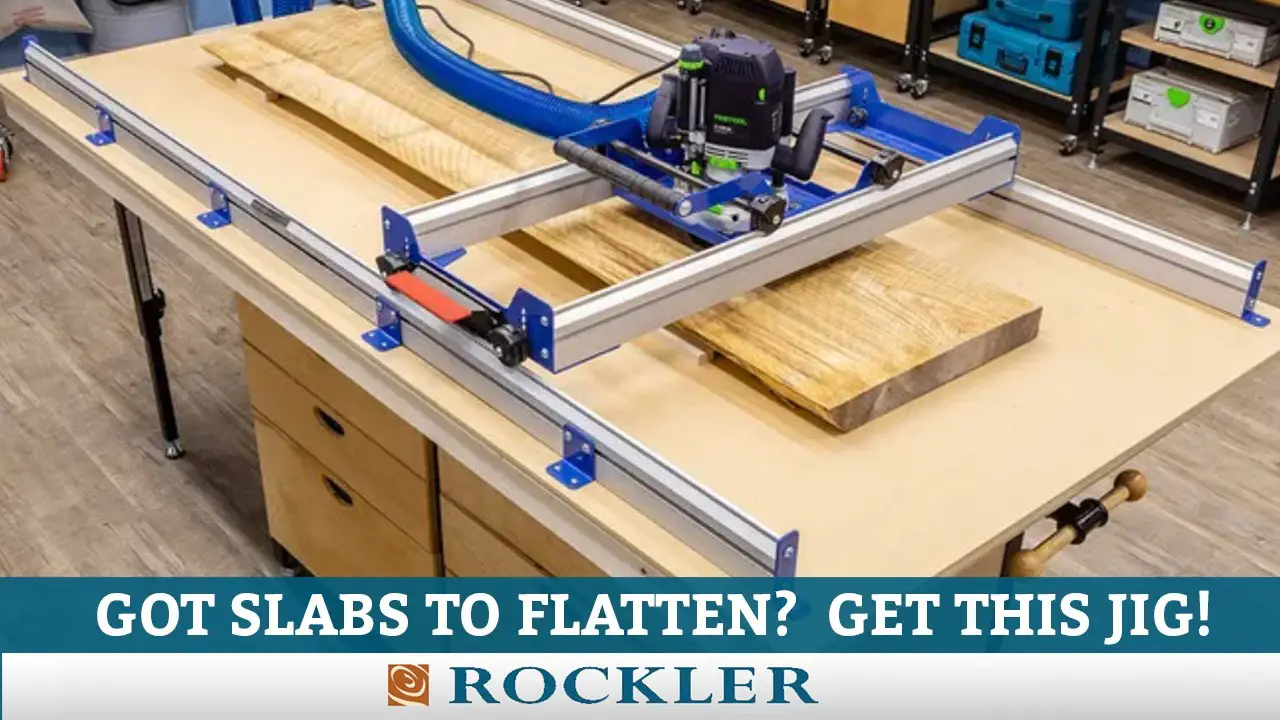
| Rockler Full-Size Slab Flattening Jig | Best Complete System | $629.99 | 28.5″ × 78.5″ |
| Woodpeckers Slab Flattening Mill Pro | Best Premium/Professional | Higher-end | Up to 48.5″ × 134″ |
| VEVOR Router Sled | Best Budget Option | $199.90 | Up to 64″ length |
| DIY Router Sled | Best for Occasional Use | ~$50–$150 | Custom |
*Prices can change.
Best Overall: Woodpeckers Router Sled 4896
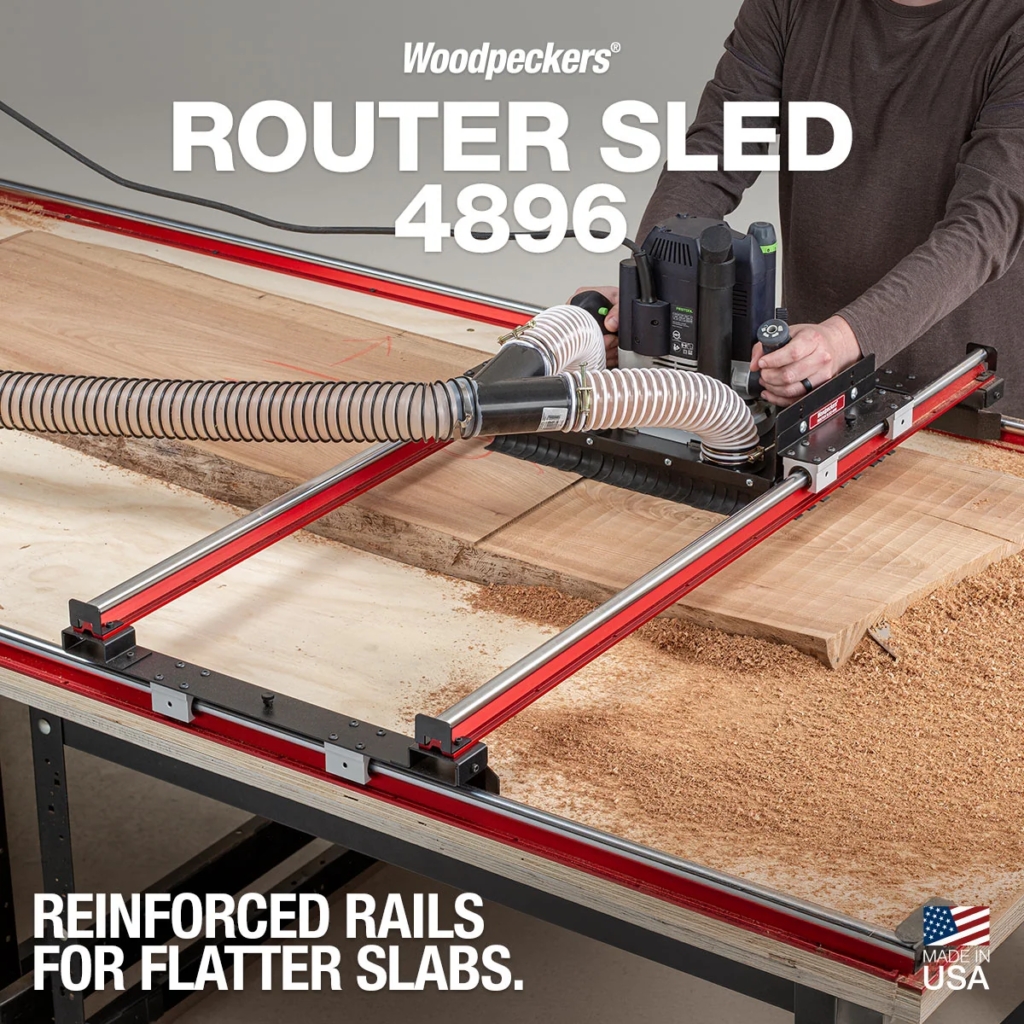
For most serious woodworkers, the Woodpeckers Router Sled 4896 is probably the best balance between price, capacity, rigidity, and professional construction.
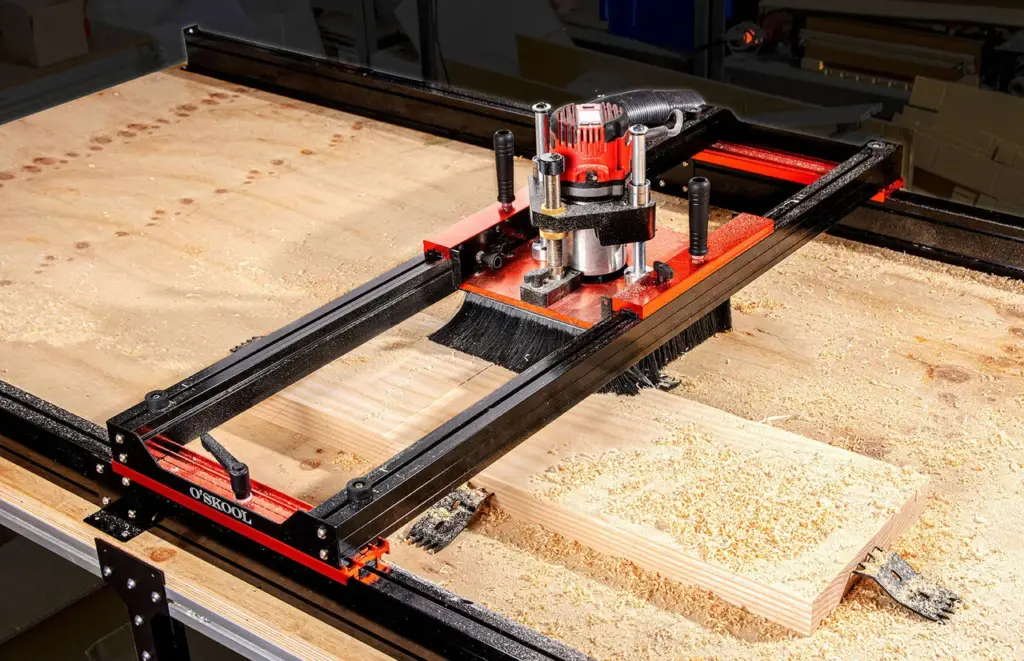
It uses case-hardened steel rails attached to rigid aluminum spines, while the router carriage itself is made from 13-gauge steel. That combination is important because rail deflection is one of the biggest problems with inexpensive or poorly designed router sleds.
With a 2-inch surfacing bit, the 4896 can handle workpieces approximately 36 inches wide and 87 inches long. It can also flatten tabletops up to about 3 inches thick, and thicker slabs can be accommodated by raising the rails with spacers.
At the time of this review, Woodpeckers lists it at approximately $599.99.
- What I Like
The biggest advantage is rigidity.
A router and large surfacing bit put a surprising amount of weight and cutting force on the cross rails. If those rails flex even slightly in the center, you can end up machining a shallow bowl rather than a flat slab.
The reinforced construction of the 4896 is specifically designed to minimize this problem.
Another good feature is the adjustable-height router sled. Instead of rebuilding your platform every time slab thickness changes, you can position the carriage closer to the workpiece and then use the router’s normal depth adjustment for fine control.
You also get low-profile slab clamping dogs.
- Dust Collection
Dust collection is optional rather than standard.
Woodpeckers offers a dust collection kit with a full-surround curtain, two extraction points, and fittings for either 2-1/2-inch dust hose or common 2-1/4-inch shop-vac hose.
That is worth considering because slab flattening produces an enormous quantity of chips.
- Downsides
The obvious drawback is price.
Around $600 is a significant investment for a jig, especially if you only expect to flatten one or two slabs.
Dust collection also costs extra.
But for someone building dining tables, epoxy river tables, desks, countertops, benches, or live-edge furniture regularly, I think the additional rigidity and repeatability justify the cost.
- Verdict
Rating: 9.2/10
Best choice for most serious hobbyists and small professional shops.
Rockler Full-Size Slab Flattening Jig
The Rockler Full-Size Slab Flattening Jig is the closest competitor and arguably the better choice if you value smooth carriage movement and an out-of-the-box dust-control system.
At approximately $629.99, it is very close in price to the Woodpeckers 4896.
Its maximum standard workpiece capacity is:
- 28-1/2 inches wide
- 78-1/2 inches long
- 2-3/4 inches thick with the dust boot installed
- Approximately 3-1/4 inches thick with the dust boot removed
Rockler recommends a 1/2-inch-shank surfacing bit and permits router bits up to 2-1/2 inches in diameter.
- Why It Stands Out
Rockler uses precision rails combined with a wheeled carriage and trolley.
That makes moving a heavy router over the slab relatively smooth compared with simple sled designs where metal or plastic surfaces slide directly against each other.
Another advantage is that the system already includes a dust boot.
Considering how messy slab flattening is, this is more important than it might initially seem.
- Router Compatibility
The baseplate is already drilled for many popular routers, including models from:
- Bosch
- DeWalt
- Festool
- Makita
- Porter-Cable
- Skil
- Triton
Among others.
- What I Don’t Like
Capacity is the biggest limitation.
A 28.5-inch maximum width is fine for benches, desks and narrower slabs, but many dining-table slabs exceed 30 inches.
Rockler does sell a rail extension kit, but that adds roughly another $240 to the setup.
- Verdict
Rating: 9/10
Excellent system, particularly if your slabs fit within its standard capacity.
If choosing between this and the Woodpeckers 4896, I would choose:
Woodpeckers for larger slabs and maximum rigidity.
Rockler for a refined complete system with integrated dust management and smooth movement.
Best Premium Router Sled: Woodpeckers Slab Flattening Mill Pro
If slab furniture is part of your business rather than an occasional hobby project, the Woodpeckers Slab Flattening Mill Pro moves into another category.
The Pro version increases capacity considerably and incorporates features designed for repetitive slab processing.
The regular Pro configuration handles approximately 48.5 × 58 inches, while the Pro XL extends the maximum workpiece length to roughly 134 inches.
That means the XL version can accommodate slabs more than 11 feet long.
The Pro carriage also offers five height positions totaling about 2-1/2 inches of adjustment, and Woodpeckers specifies a maximum slab thickness around 3-3/8 inches in its highest configuration.
- Integrated Dust Collection
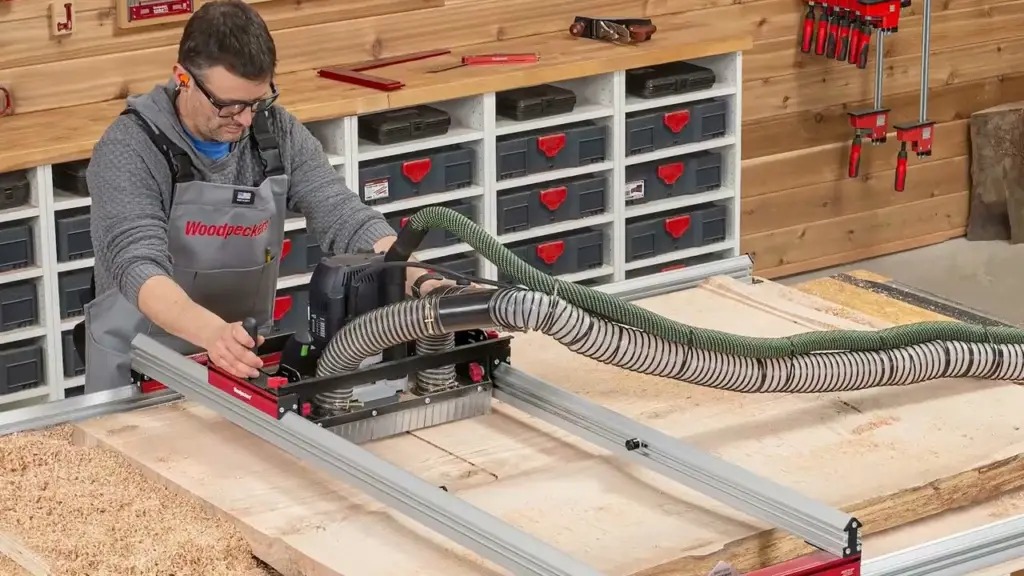
Unlike the basic Woodpeckers system, the Pro has dust collection built into the carriage.
It uses two pickup points and a flexible curtain surrounding the cutting area.
For a commercial shop, that alone is a significant improvement.
- EZ-Drive
Then there is the optional EZ-Drive system.
Instead of physically pushing the router from side to side and repeatedly repositioning the carriage, two hand cranks drive the system using synchronized cogged belts.
One crank controls cross-travel while the other controls movement along the slab.
This reduces fatigue, especially on four-foot-wide slabs where constantly reaching across the workpiece becomes uncomfortable.
The EZ-Drive upgrade alone is currently listed around $569.99, so this configuration clearly targets frequent users rather than occasional DIY projects.
- Verdict
Rating: 9.5/10 for professional use
Probably overkill for a hobbyist.
For a furniture shop flattening slabs every week, however, the additional capacity, dust collection and crank drive can save a substantial amount of labor.
Best Budget Router Sled: VEVOR
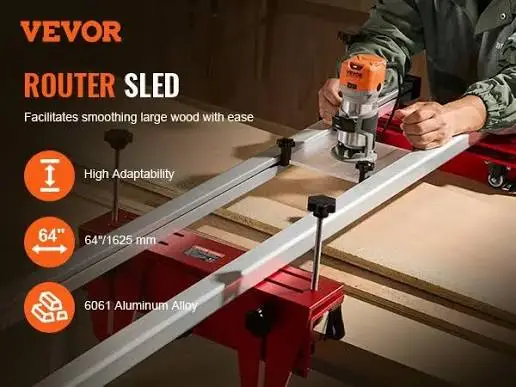
If spending $600–$1,000 on a sled doesn’t make sense, VEVOR offers a dramatically cheaper alternative.
The current 60-inch-style VEVOR slab flattening system is listed at approximately $199.90 and provides up to about 64 inches of working length, along with adjustable router mounting and roughly 0–5.5 inches of height adjustment.
That’s a lot of hardware for the money.
- Is It Any Good?
For occasional woodworking, potentially yes.
Recent woodworking community feedback provides a good example. One VEVOR sled owner reported being happy with the system and considered it worth purchasing for their setup.
However, another owner working with thin 3/4-inch maple found that even at the sled’s lowest setting, the router bit couldn’t reach the material without raising the workpiece.
That’s not necessarily a major problem—a sacrificial MDF platform can raise thin material—but it illustrates the difference between inexpensive universal systems and more refined professional sleds.
- Verdict
Rating: 8/10
A very attractive option for someone flattening a few slabs per year.
If you are starting a slab-furniture business, I’d invest in a more rigid professional system.
Should You Just Build a DIY Router Sled?
Possibly.
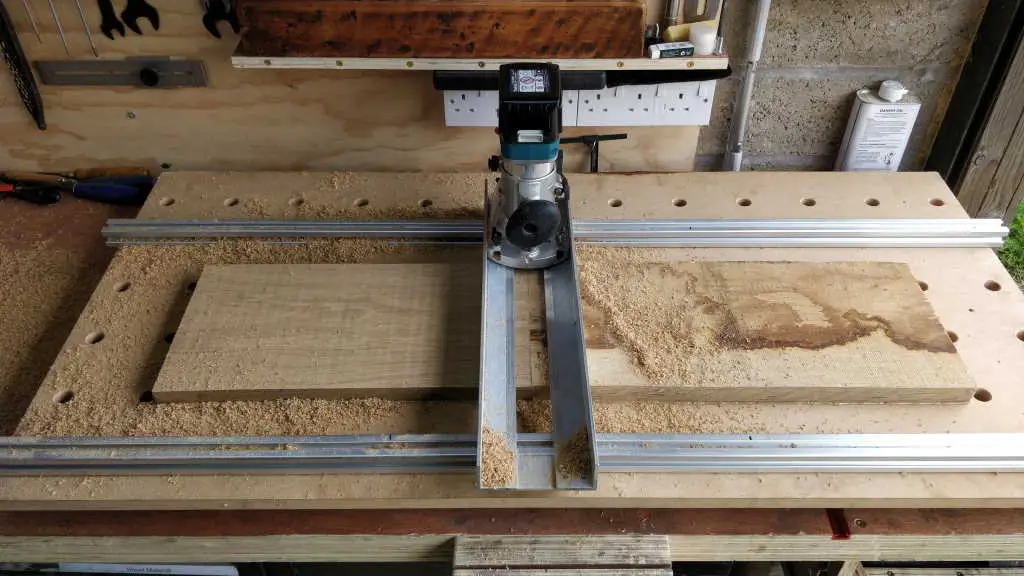
A router sled is fundamentally simple:
Two parallel rails support another pair of cross rails, and a router moves across those rails.
A DIY version can be constructed from:
- Plywood
- MDF
- Aluminum extrusion
- Steel angle
- Linear rails
- Acrylic or polycarbonate
- Combination systems
Recent woodworking discussions still frequently recommend building a simple sled before spending several hundred dollars on a commercial version, particularly for beginners.
But there is one major warning.
Rigidity Matters More Than Almost Anything Else
Cheap rails can flex.
Several woodworkers who built their own systems have reported sagging cross rails when heavy routers were placed near the center.
Even a tiny amount of deflection matters.
Imagine your rails sag only 1/32 inch under the router.
Your freshly surfaced slab could potentially inherit that same curvature.
So if building your own system, don’t focus only on making something that slides smoothly.
Focus on making something that doesn’t flex.
What Makes a Good Router Sled?
There are six features I would evaluate before buying one.
1. Rail Rigidity
This is number one.
The rails must remain straight while supporting:
- The router
- Router carriage
- Large surfacing bit
- Downward pressure from the operator
- Cutting forces
Extruded aluminum, reinforced steel and supported linear rails generally outperform thin angle material.
2. Slab Capacity
Don’t buy based on the slab you’re working on today.
Think about the largest slab you’re realistically likely to flatten.
For dining tables, I would want at least around 36 inches of working width.
For wide live-edge slabs, 48 inches or more is even better.
3. Router Compatibility
Large slabs benefit from a powerful variable-speed router.
You can technically flatten material with smaller routers, but a large 1-1/2- to 2-inch surfacing cutter places considerably more load on the motor.
A router capable of using 1/2-inch-shank bits is preferable for serious flattening work.
What Router Bit Should You Use?
A dedicated slab-flattening or spoilboard bit is significantly better than trying to perform the job with a small straight bit.
Common sizes include:
1 inch: smaller routers and smaller projects.
1-1/2 inches: excellent general-purpose size.
2 inches: faster material removal on large slabs.
Woodpeckers offers slab-flattening bits between 1 and 2 inches in diameter, with its larger 1-1/4-, 1-1/2- and 2-inch versions using 1/2-inch shanks.
Rockler’s full-size slab bit is 2 inches in diameter with a 1/2-inch shank and rounded cutter corners intended to reduce visible gouging where adjacent passes overlap.
Don’t Automatically Run a Huge Bit at Maximum RPM
Larger diameter router bits generally require lower speeds.
Always follow the bit manufacturer’s maximum RPM recommendation rather than simply turning the router to maximum speed. Experienced users also recommend watching for burning and reducing speed or feed rate appropriately.
The Secret to Getting a Truly Flat Slab
Buying an expensive router sled does not automatically produce a flat slab.
Your rails have to define a flat plane.
This is one of the most overlooked parts of the entire process.
Woodpeckers specifically recommends mounting its flattening mill on a well-supported, flat surface and checking the work surface with a straightedge before beginning.
The two long rails must also be coplanar.
If one rail is twisted relative to the other, your router will reproduce that twist in the slab.
A user experiencing inconsistent results with a Woodpeckers mill eventually discovered the supporting surface itself wasn’t flat—exactly the type of setup error that can compromise an otherwise accurate sled.
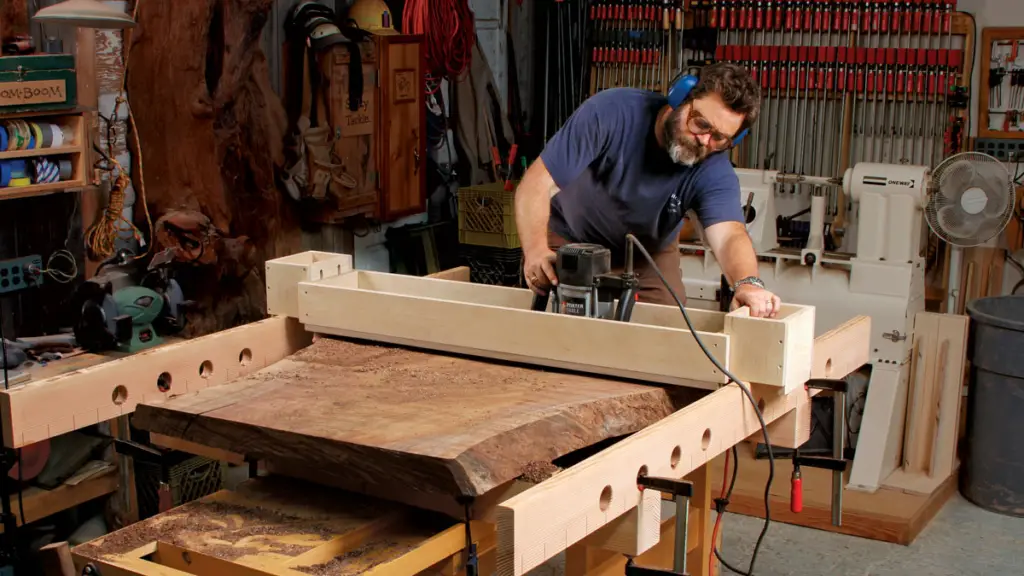
How to Flatten a Slab With a Router Sled
Step 1: Prepare the Base
Use a flat, rigid surface.
A heavy workbench topped with MDF or high-quality plywood works well.
Support the sheet adequately so it doesn’t sag.
Step 2: Install the Rails
Position both rails parallel to each other.
Use a long straightedge, winding sticks, level or precision setup method to make sure they lie in the same plane.
Remember:
Level isn’t technically the goal—coplanar is.
The sled can be slightly tilted relative to the earth and still produce a flat slab as long as both rails remain in the same plane.
Step 3: Secure the Slab
Place the slab between the rails.
Shim underneath any unsupported areas so it cannot rock.
Then clamp it securely.
The slab must not move while machining.
Step 4: Find the Highest Point
Move the router over the slab with the machine turned off.
Lower the bit until it barely touches the highest point.
That establishes your first cutting height.
Step 5: Make Shallow Passes
Don’t try to remove a large amount of material in one pass.
Multiple shallow passes:
- Put less stress on the router
- Reduce vibration
- Improve surface quality
- Reduce tear-out
- Extend cutter life
Step 6: Overlap Each Pass
Move across the workpiece systematically, overlapping passes instead of leaving strips between them.
Once the router reaches the end, move the carriage forward slightly and repeat.
Step 7: Flip the Slab
Once the first side is flat, flip the slab.
Now the newly flattened face becomes your reference surface.
Secure it and machine the opposite side until the desired final thickness is reached.
Why Do Router Sleds Leave Lines?
This is one of the most common complaints.
Small ridges between router passes usually come from one of four problems:
Router Isn’t Perfectly Trammed
The router bit isn’t exactly parallel with the slab surface.
One edge of the cutter therefore sits slightly lower than the other.
Rails Are Flexing
The router sinks slightly when it reaches the center of the cross rails.
Passes Are Too Aggressive
Excessive cutting depth causes vibration or chatter.
Dull or Poor-Quality Bit
A quality surfacing cutter can make a dramatic difference.
You will almost always need some sanding afterward, but a properly adjusted sled should not leave deep ridges requiring aggressive sanding.
Dust Collection Is Not Optional for Long
Flatten one large slab without dust extraction and you’ll understand why.
A 2-inch cutter can convert a surprising amount of hardwood into chips within minutes.
If your sled offers a dust boot, use it.
Even with dust extraction, wear appropriate respiratory, eye and hearing protection when routing.
Router Sled vs Planer
A planer wins for normal boards.
It’s much faster.
But it has two limitations:
Width and reference surface.
A 13-inch planer can’t process a 35-inch tabletop.
A router sled doesn’t care whether the workpiece is 12, 24 or 48 inches wide—as long as it fits between the rails.
That’s why router sleds are especially valuable for:
- Live-edge slabs
- Epoxy river tables
- Large glued-up tabletops
- Workbench tops
- Countertops
- Cutting boards
- Oversized panels
Router Sled vs CNC
A CNC can perform essentially the same surfacing operation automatically.
But a CNC large enough to handle an eight-foot dining table can be extraordinarily expensive and consumes substantial shop space.
A router sled gives small shops much of the flattening capability without requiring a full-size CNC machine.
Which Router Sled Should You Buy?
Here is how I would make the decision.
Buy the VEVOR if:
You’re flattening one or two slabs.
You’re a hobbyist.
Your budget is under $300.
You don’t mind spending more time setting up the jig.
Buy the Woodpeckers Router Sled 4896 if:
You regularly build tables.
You want excellent rigidity.
You need approximately 36 inches of width.
You want professional-quality results without buying the company’s top-end system.
Buy the Rockler Full-Size Jig if:
Your slabs fit within roughly 28.5 inches.
You value smooth wheeled movement.
You want dust collection included in the basic system.
Buy the Woodpeckers Slab Flattening Mill Pro if:
Slab furniture is part of your business.
You routinely work with large dining tables.
You need up to roughly 48.5 inches of width.
You want integrated dust collection.
You may eventually want crank-driven EZ-Drive movement.
Build Your Own if:
You’ll probably use the sled only a handful of times.
A properly constructed DIY router sled can work extremely well.
Just don’t underestimate rail rigidity.
Final Verdict
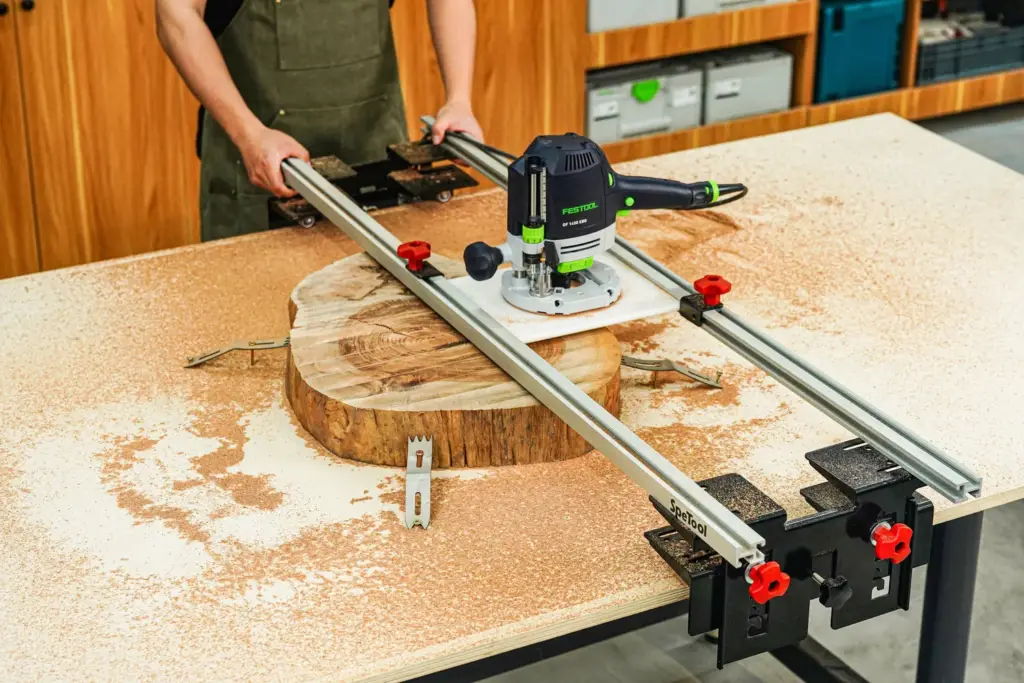
Best Overall: Woodpeckers Router Sled 4896
If I were setting up a woodworking shop today and wanted one slab-flattening system without spending professional-CNC money, this is the one I would choose.
It has enough capacity for most table projects, rigid steel-and-aluminum construction, adjustable height and a professional carriage while remaining considerably simpler than Woodpeckers’ premium systems.
Best Alternative: Rockler Full-Size Slab Flattening Jig
If your projects fit within its 28.5-inch width limitation, Rockler’s smooth wheeled system, included dust boot and broad router compatibility make it an excellent alternative.
Best Budget Choice: VEVOR
For around one-third the cost of the premium systems, the VEVOR makes slab flattening accessible to occasional users. Just expect more setup compromises and make sure your supporting surface and rails are carefully calibrated.
Best Professional Choice: Woodpeckers Slab Flattening Mill Pro + EZ-Drive
For repeated commercial slab work, the larger capacity, integrated dust collection and optional crank-controlled movement make the Pro system the strongest option of this group.
The most important lesson, though, is that the sled itself is only half of the system.
A $1,000 router sled mounted on a warped table can produce worse results than a carefully built $100 DIY sled.
Rigid rails + a flat reference plane + a quality router bit + shallow controlled passes = a genuinely flat slab.
READ ALSO: Worm Drive vs. Direct Drive