
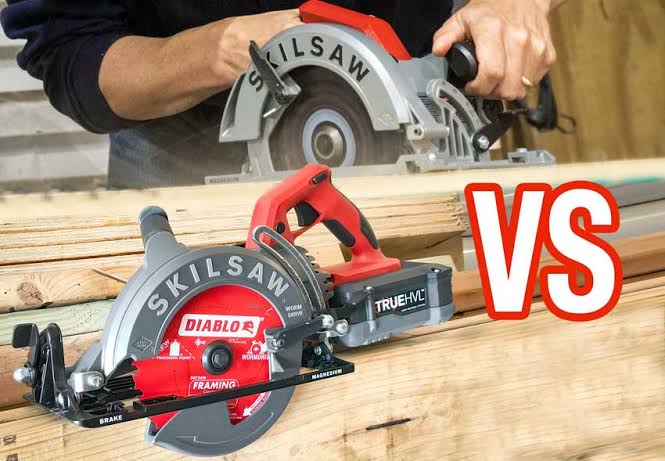
Worm Drive vs. Direct Drive
Table of Contents
Worm Drive vs. Direct Drive: Which Circular Saw Is Better?
Choosing between a worm drive and a direct drive circular saw can be confusing because both tools perform essentially the same job: cutting lumber, plywood, OSB, and other sheet materials. The difference is in how power travels from the motor to the blade—and that difference affects torque, speed, weight, balance, maintenance, and the way the saw feels during a cut.
Worm drive saws have traditionally been associated with heavy-duty framing and demanding professional work, while direct drive saws—also called sidewinders—are lighter, faster, and more common among both contractors and DIY users.
Modern cordless technology has blurred the distinction considerably, but the basic designs still have advantages and disadvantages worth understanding.
Worm Drive vs. Direct Drive at a Glance
| Feature | Worm Drive | Direct Drive / Sidewinder |
|---|---|---|
| Motor position | Behind the blade | Beside the blade |
| Drive system | Worm gear | Spur/direct gearing |
| Torque | Higher traditionally | Lower traditionally |
| Blade speed | Generally lower | Generally higher |
| Size | Longer and narrower | Shorter and wider |
| Weight | Heavier | Lighter |
| Handling | Excellent for long cuts | Easier to maneuver |
| Maintenance | Some require gear oil | Usually minimal |
| Typical blade position | Left | Right |
| Best suited for | Framing, ripping, heavy lumber | General construction, crosscuts, DIY |
Traditional corded worm drives commonly trade blade speed for greater torque, while sidewinders tend to use higher RPM and a lighter, more compact arrangement. Modern brushless cordless saws complicate this comparison because they can deliver extremely high power without using traditional worm gearing.
What Is a Worm Drive Circular Saw?
A worm drive circular saw places its motor behind the blade rather than alongside it. The motor shaft runs roughly parallel with the blade, and a worm-gear arrangement transfers power through a 90-degree angle to drive the blade.
This gearing is the defining characteristic of a true worm drive.
One major result is torque. The gear arrangement can provide substantial load-carrying capability, helping the blade continue cutting when it encounters dense, thick, wet, or otherwise difficult material.
The design also produces the familiar shape of a worm drive saw: long, relatively narrow, and equipped with a rear handle.
Worm Drive Advantages
The biggest advantage is traditionally high torque under load. That makes worm drives particularly comfortable when ripping long pieces of dimensional lumber, cutting stacks of sheet material, or working through construction lumber that can cause a less powerful saw to bog down.
Their long body can also work surprisingly well for ripping. Rather than feeling like you’re steering a small handheld saw, the machine tends to track forward through the material.
Another advantage for many right-handed operators is visibility. Traditional worm drives frequently use a blade-left configuration, making the cut line easy to see from the operator’s position.
Worm Drive Disadvantages
Weight is the obvious drawback.
A traditional worm drive is noticeably heavier than a conventional sidewinder. That may not bother you when you’re ripping plywood on sawhorses, but it becomes far more noticeable when making repetitive cuts or working in awkward positions.
The long body also requires more room.
Finally, true worm gearboxes may require periodic lubrication. This isn’t universal—some related gear-driven designs use sealed lubrication systems—but maintenance requirements should be checked before buying.
What Is a Direct Drive Circular Saw?
A direct drive circular saw is more commonly called a sidewinder.
Here, the motor sits next to the blade instead of behind it. A relatively simple gearing arrangement transfers power to the blade.
The result is a much shorter saw.
It’s the familiar circular-saw shape you’ll see in workshops, garages, construction sites, and home-improvement stores.
Because the design uses fewer gears, direct drive saws are generally lighter and require less drivetrain maintenance than traditional worm drives.
Direct Drive Advantages
Weight is arguably the biggest advantage.
A lighter circular saw is easier to control when you’re making dozens—or hundreds—of cuts. It’s particularly useful when working above waist height, climbing ladders, remodeling in tight spaces, or making cuts where the saw isn’t simply resting flat on a sheet of plywood.
Sidewinders are also compact.
That can make them much easier to maneuver around a crowded workshop or jobsite.
Another advantage is blade speed. Traditional corded sidewinders frequently run at higher RPM than worm drives. As one general comparison, worm drives may operate around the low-to-mid 4,000-RPM range while direct-drive models can reach roughly 6,000 RPM or more, although actual specifications vary substantially by model.
Direct Drive Disadvantages
Historically, the tradeoff has been torque.
A conventional corded sidewinder doesn’t have the same mechanical torque characteristics as a traditional worm drive with comparable motor power.
That doesn’t mean a sidewinder is weak. For ordinary framing lumber, plywood, decking, and home-improvement work, a quality direct drive saw has plenty of power.
The distinction has become even less important with modern brushless cordless motors.
Torque vs. Speed
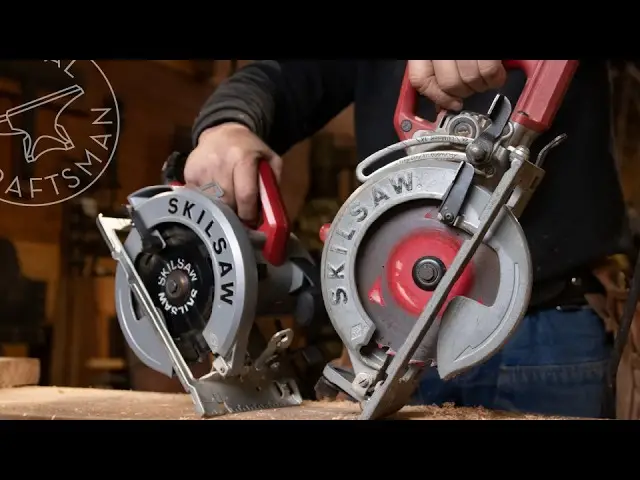
This is one of the most important differences.
A simplified way to think about the two designs is:
Worm drive = torque
Direct drive = speed
The worm gear arrangement provides greater torque multiplication, which is useful when the blade encounters substantial resistance.
Direct drive saws typically compensate with higher blade speed.
That makes a sidewinder feel quick and responsive when making normal cuts, while a traditional worm drive can feel more relentless when pushed through demanding material.
However, you shouldn’t choose a modern saw based on RPM alone.
Motor power, electronics, gearing, blade quality, battery voltage, battery discharge capability, and thermal management can all affect how quickly a saw actually completes a cut.
Cutting Performance
For normal 2x4s, plywood, OSB, and similar materials, either design performs extremely well.
Differences become easier to notice when workloads get tougher.
Long Rip Cuts
Winner: Worm Drive
The long body, rear handle, torque, and forward-oriented balance make traditional worm drives excellent ripping machines.
They are particularly comfortable when making long cuts through plywood, OSB, and dimensional lumber.
Crosscuts
Winner: Direct Drive
For repeated crosscuts, the lower weight and compact dimensions of a sidewinder are difficult to beat.
Pick it up, make the cut, put it down, and repeat.
Thick or Difficult Lumber
Winner: Worm Drive
Traditional worm drives excel when the blade remains heavily loaded for extended periods.
Pressure-treated lumber, engineered lumber, wet framing lumber, and stacked materials are classic worm-drive territory.
Overhead and Awkward Cuts
Winner: Direct Drive
This is where every extra pound matters.
A lighter sidewinder is considerably more pleasant when you’re holding the saw rather than allowing the work surface to support its weight.
Weight and Ergonomics
Don’t underestimate this category.
A more powerful saw isn’t necessarily a better saw if you’re exhausted after using it all day.
Traditional worm drives tend to be heavier because of their gearbox and elongated construction. Direct drives are generally lighter and easier to maneuver.
For a framing contractor making long cuts on supported material, the additional weight may actually help stabilize the tool.
For someone remodeling a house and frequently moving between different cutting positions, the lighter direct drive may be much more convenient.
So there’s no universal ergonomic winner.
It depends on how you cut.
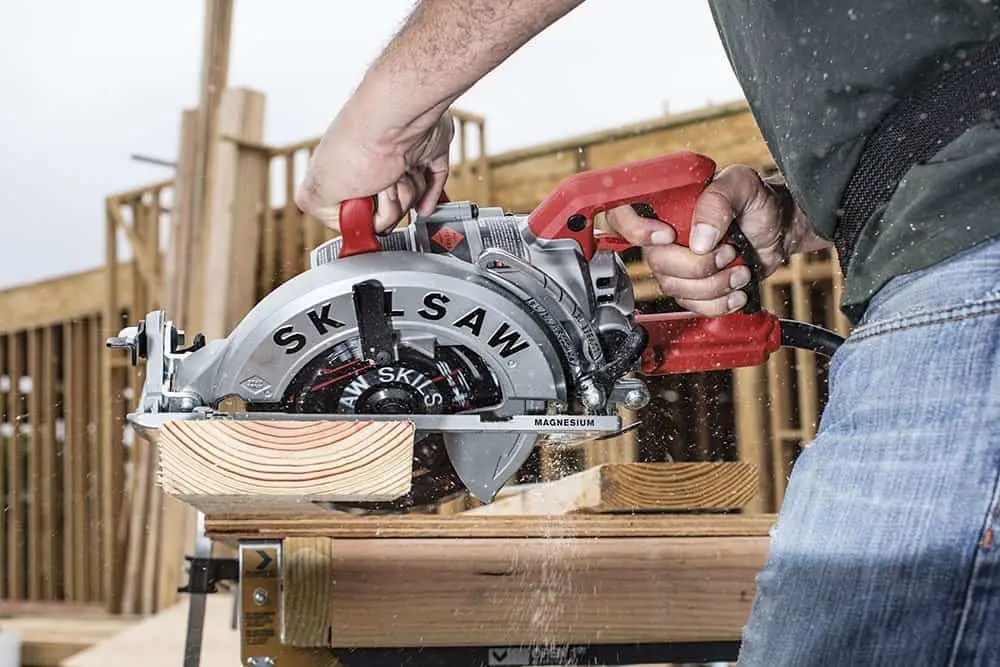
Blade Left vs. Blade Right
People sometimes assume:
- Worm drive = blade left
- Direct drive = blade right
That’s historically common, but it’s no longer a reliable rule.
There are now direct drive saws with blade-left arrangements and rear handles, along with numerous other configurations.
Blade position affects both visibility and balance.
A right-handed operator may appreciate a blade-left saw because the cutting line can be easier to see. Conversely, blade-right designs can place more of the saw’s shoe on the supported portion of the workpiece depending on how the cut is arranged.
Neither orientation is inherently superior.
If possible, physically hold both configurations before choosing.
Maintenance
This is an area where direct drive has a clear simplicity advantage.
Traditional worm drive gearboxes can require lubrication. Owners should check the manufacturer’s instructions concerning oil level and replacement intervals.
A sidewinder generally doesn’t require this drivetrain maintenance because its gearing is simpler.
There’s also a third category worth mentioning: hypoid saws.
Hypoid gearing can provide the long-body, high-torque characteristics associated with worm-drive-style saws while using a different gear design. Some hypoid systems are sealed and permanently lubricated, eliminating routine gearbox oil servicing.
The Cordless Saw Problem: “Worm Drive Style” Isn’t Always Worm Drive
This is probably the most important detail when shopping for a modern circular saw.
A saw can look like a worm drive without actually containing worm gears.
You’ll see cordless saws advertised as:
- rear-handle saws;
- worm-drive-style saws;
- rear-handle circular saws.
These descriptions can refer primarily to the physical layout.
The saw may have the motor behind the blade, a long body, rear handle, and blade-left configuration while still using a direct-drive drivetrain.
Why?
Modern brushless motors can produce enormous torque without needing a traditional worm gearbox.
As a result, when comparing cordless saws, the old assumption that “worm drive automatically means more powerful” becomes much less useful. Contemporary cordless direct-drive designs can match or exceed the cutting performance traditionally associated with corded worm drives.
For cordless models, you’re often really deciding between:
traditional top-handle/sidewinder ergonomics vs. rear-handle ergonomics.
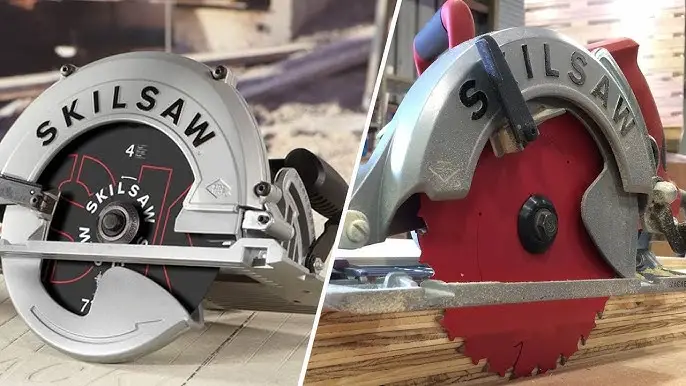
Corded Worm Drive vs. Corded Direct Drive
With corded saws, the traditional differences remain much clearer.
Choose a corded worm drive if your priorities are:
- demanding framing;
- long rip cuts;
- high sustained torque;
- heavy construction lumber;
- professional jobsite durability.
Choose a corded direct drive if your priorities are:
- lower weight;
- easier maneuverability;
- general woodworking;
- remodeling;
- frequent crosscuts;
- occasional rather than continuous heavy cutting.
For many homeowners, a direct-drive saw is simply easier to live with.
Cordless Worm-Drive-Style vs. Cordless Sidewinder
With cordless saws, things get much more interesting.
Modern high-output batteries and brushless motors have dramatically reduced the performance gap.
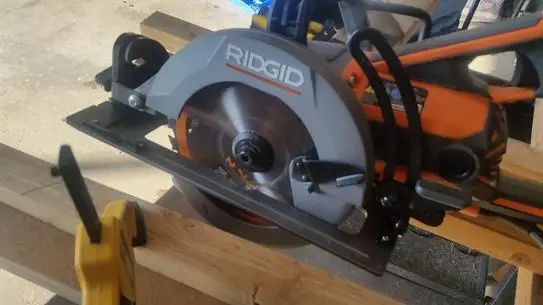
A high-powered rear-handle cordless saw can offer tremendous cutting performance while retaining the long, balanced feel contractors associate with traditional worm drives.
A conventional cordless sidewinder can deliver similarly impressive performance while remaining shorter and often easier to maneuver.
Consequently, the decision increasingly comes down to:
rear handle vs. conventional handle
and
blade left vs. blade right
rather than simply worm gearing vs. direct gearing.
Which Is Better for DIY?
For most homeowners:
Direct Drive Wins
A sidewinder is generally:
- lighter;
- easier to learn;
- easier to store;
- easier to maneuver;
- lower maintenance;
- powerful enough for most household projects.
If you’re building shelves, repairing a deck, cutting plywood, framing occasional walls, or doing general renovations, there’s little reason you need a traditional worm drive.
That doesn’t mean you shouldn’t buy one—just that its advantages may not outweigh the additional weight.
Which Is Better for Professional Framing?
This is much closer.
Traditional worm drives earned their reputation on framing jobsites for good reason.
Their torque, long body, rear handle, and tracking characteristics make them excellent for demanding construction work.
But modern cordless rear-handle saws have changed the equation dramatically.
Professional users should therefore evaluate the entire saw rather than simply looking for the words “worm drive.”
Consider:
- cutting speed under load;
- weight;
- balance;
- battery runtime;
- blade position;
- depth of cut;
- bevel capacity;
- ergonomics;
- dust management;
- brake performance.
Worm Drive Pros and Cons
Pros
- Excellent torque
- Great for demanding cuts
- Tracks nicely during long rips
- Well suited to framing
- Narrow body
- Rear-handle ergonomics
- Often excellent cut-line visibility
- Designed for demanding jobsite use
Cons
- Heavier
- Longer
- Can be tiring during repetitive work
- Traditional designs may require lubrication
- Less convenient for awkward cuts
- Often unnecessary for light DIY work
Direct Drive Pros and Cons
Pros
- Lightweight
- Compact
- Easy to maneuver
- Higher blade speeds traditionally
- Simple drivetrain
- Minimal drivetrain maintenance
- Excellent general-purpose design
- Comfortable for repetitive cutting
Cons
- Traditional corded models generally offer less torque
- Wider motor housing
- May bog more easily during extreme cuts
- Conventional ergonomics aren’t as comfortable for everyone during long rip cuts
Worm Drive vs. Direct Drive: Who Wins?
There isn’t one universal winner.
- Best for heavy framing:
Worm Drive
- Best for long rip cuts:
Worm Drive
- Best for thick and demanding material:
Worm Drive
- Best for portability:
Direct Drive
- Best for overhead work:
Direct Drive
- Best for general DIY:
Direct Drive
- Best for minimal maintenance:
Direct Drive
- Best for repetitive crosscuts:
Direct Drive
- Best overall for most homeowners:
Direct Drive
- Best traditional corded design for demanding professionals:
Worm Drive
Final Verdict
The classic argument that worm drives are powerful and sidewinders are lightweight is still broadly accurate for traditional corded circular saws.
A worm drive makes the most sense when you’re regularly pushing a saw hard. Heavy framing, long rips, thick lumber, and demanding jobsite work take advantage of its torque and rear-handle design.
A direct drive makes more sense for most other users. It’s lighter, shorter, easier to maneuver, requires less drivetrain maintenance, and still provides more than enough cutting performance for typical construction and DIY projects.
But cordless technology has changed the comparison.
A modern rear-handle cordless circular saw may look and behave like a worm drive while actually using direct-drive technology. At the same time, today’s brushless sidewinders can produce levels of power that would have been extraordinary for compact circular saws in the past.
So if you’re buying a corded saw, the worm-drive-versus-direct-drive distinction still matters considerably.
If you’re buying a cordless saw, focus less on the name of the drivetrain and more on actual cutting performance, weight, balance, blade orientation, battery platform, and handle configuration.
For most DIYers and general contractors, a quality direct drive is the better all-around choice. For professionals who spend their days ripping framing lumber and want maximum torque with classic rear-handle ergonomics, the worm drive remains difficult to beat.
READ ALSO: How to choose Dust Collection Air Flow?