
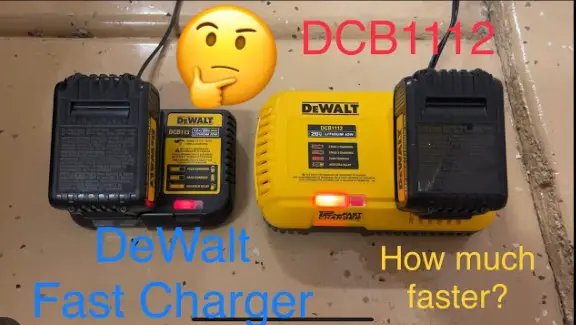
How Long Do DeWALT Batteries Take To Charge?
If you use DeWALT cordless tools regularly, knowing how long your batteries take to charge can make a big difference to your workflow. A small battery may be ready in well under an hour, while a large FLEXVOLT pack can take significantly longer—especially when paired with a slower charger.
The biggest factor isn’t simply whether you have a 20V or 60V battery. Battery capacity, charger output, battery temperature, and the specific battery model all affect charging time.
As a general rule, most DeWALT lithium-ion batteries take about 30 minutes to 2 hours to charge, although large-capacity packs on slower chargers can take considerably longer.
Table of Contents
Quick Answer: How Long Does a DeWALT Battery Take to Charge?
For most current DeWALT batteries, expect roughly:
| Battery Size | Typical Charge Time |
|---|---|
| 1.5Ah–2.0Ah | 20–45 minutes |
| 3.0Ah | 30–60 minutes |
| 4.0Ah | 40–90 minutes |
| 5.0Ah | 45–90 minutes |
| 6.0Ah | 60–100 minutes |
| 8.0Ah | Around 60–120 minutes |
| 9.0Ah FLEXVOLT | Around 75–135 minutes |
| 12.0Ah FLEXVOLT | Around 1.5–3 hours |
| 15.0Ah FLEXVOLT | Potentially 2–4+ hours |
These are general estimates. Your actual time can vary substantially depending on your charger.
For example, an older DeWALT compatibility chart lists the popular DCB205 20V MAX 5Ah battery at approximately 75 minutes on the DCB115 charger, while slower chargers could take 112–240 minutes.
That is why asking “How long does a DeWALT battery take to charge?” really requires a second question:
Which charger are you using?
DeWALT Charger Speeds Explained
DeWALT currently offers chargers with dramatically different charging outputs.
Among the current lineup are:
- DCB1104 – 4 Amp
- DCB094K USB-C charging kit – up to 5 Amp charging capability
- DCB1106 – 6 Amp
- DCB118 – 8 Amp Fast Charger
- DCB1112 – 12 Amp Fan-Cooled Fast Charger
DeWALT also offers multiport charging systems and specialty chargers.
In simple terms, a higher-output charger can usually replenish a compatible battery faster.
However, a 12-amp charger does not necessarily charge every battery three times faster than a 4-amp charger. The battery’s internal electronics determine how much charging current it can safely accept, and charging speed typically decreases as the pack approaches full capacity.
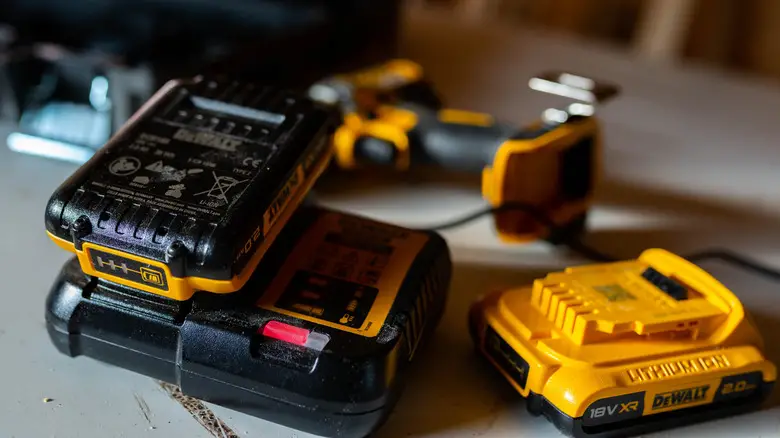
DeWALT DCB1104 4 Amp Charger
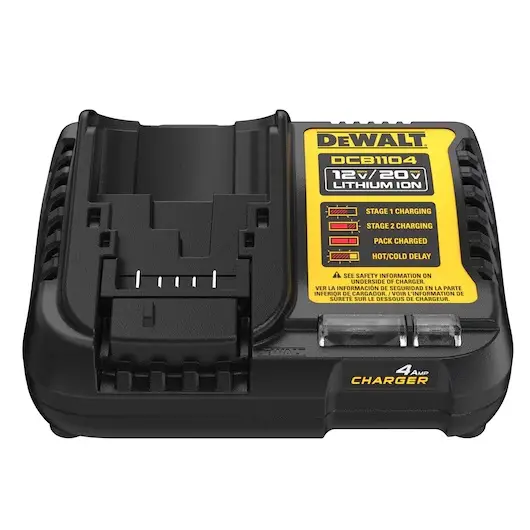
The DCB1104 is a good general-purpose charger for homeowners and anyone who isn’t constantly cycling through batteries.
It works with DeWALT 12V MAX, 20V MAX, and FLEXVOLT batteries. DeWALT describes it as a 4-amp charger and says it is 15% smaller than the older DCB115 4-amp charger.
Best for:
DIY users, workshops, garages, and people who own several batteries and don’t need the absolute shortest turnaround time.
Pros
- Compact
- Compatible with several DeWALT battery platforms
- Simple state-of-charge indicator
- Suitable for overnight or between-job charging
Cons
- Noticeably slower with large 6Ah, 9Ah, 12Ah, and larger packs
- Professional users may prefer a higher-output model
DeWALT DCB1106 6 Amp Charger
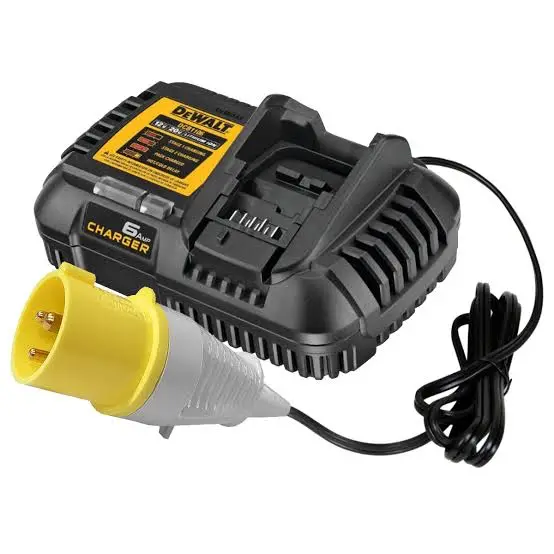
The DCB1106 increases maximum charging output to 6 amps and works with 12V MAX, 20V MAX, and FLEXVOLT batteries.
For many users, this is a useful middle ground.
It’s faster than a basic 4-amp charger without necessarily stepping up to DeWALT’s largest and more expensive fast chargers.
Best for:
Contractors and serious DIY users who regularly use 4Ah–8Ah batteries.
Pros
- Good balance between speed and practicality
- Broad DeWALT battery compatibility
- Two-stage LED charging indicator
Cons
- Still not the fastest choice for very large FLEXVOLT packs
DeWALT DCB118 8 Amp Fast Charger
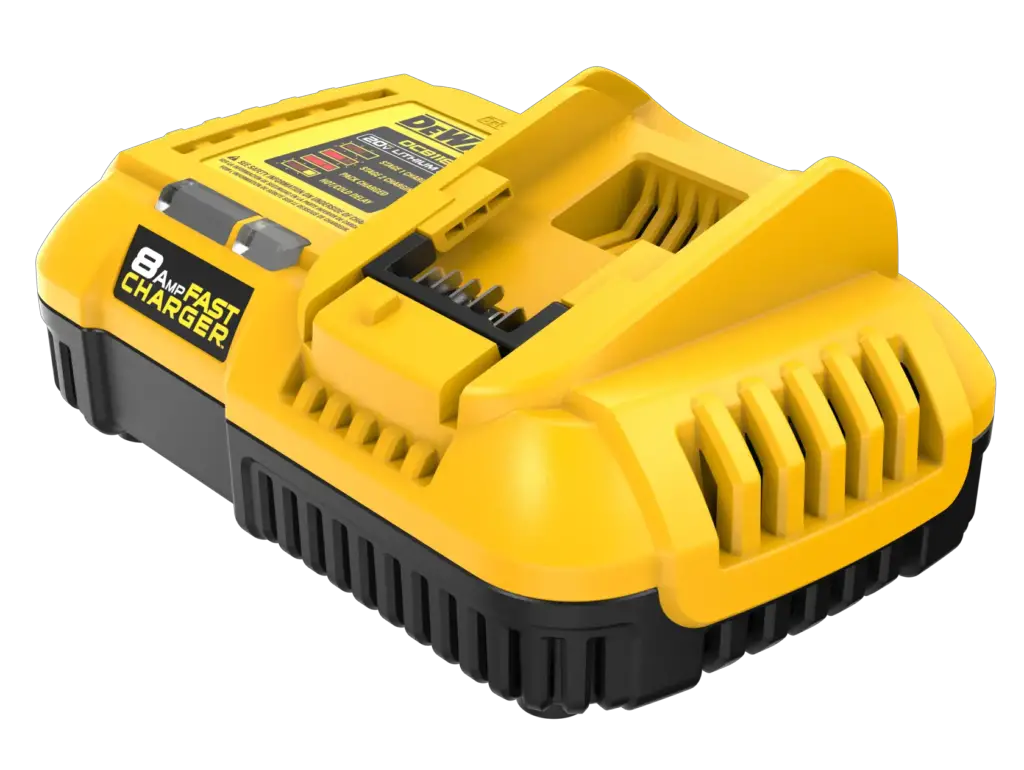
For people using demanding tools such as grinders, saws, blowers, and FLEXVOLT equipment, the DCB118 is one of DeWALT’s better-known fast chargers.
It provides up to an 8-amp charge rate and works with 20V MAX and FLEXVOLT batteries. It also includes an internal fan that moves air across the battery to reduce delays caused by excessive battery temperature.
That cooling system matters more than you might think.
If you’ve just removed a battery from a high-demand circular saw or grinder, the battery could be too hot to charge immediately. A fan-assisted charger can help manage pack temperature and get the charging process underway sooner.
Best for:
Professional users, FLEXVOLT owners, and anyone who frequently drains batteries during the working day.
Pros
- Fast 8-amp charging
- Fan-assisted cooling
- Excellent match for larger batteries
- Reduces jobsite downtime
Cons
- Larger than basic chargers
- Fan can create some noise
- More charger than occasional DIY users may need
DeWALT DCB1112 12 Amp Fast Charger
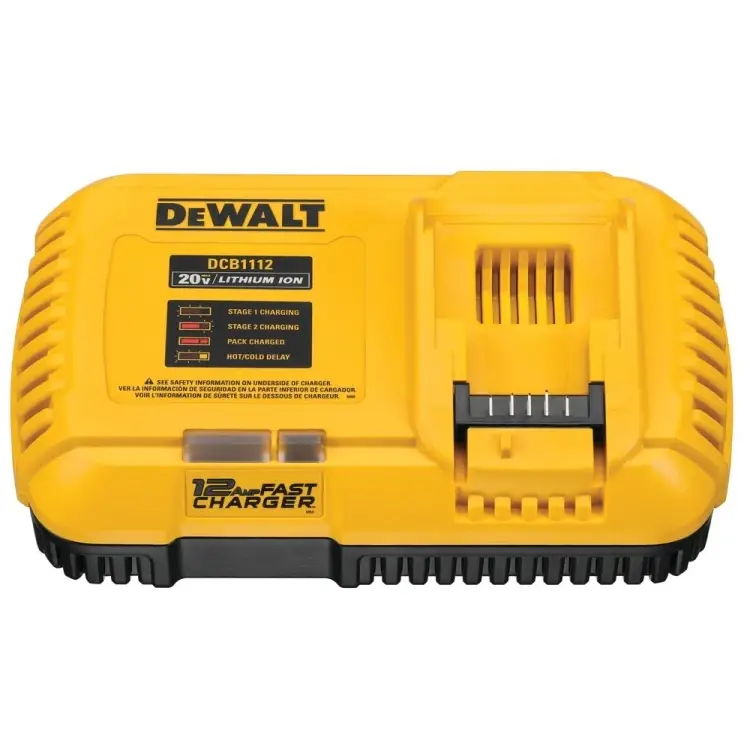
If maximum charging performance is the priority, the DCB1112 is one of DeWALT’s fastest current chargers.
DeWALT rates it at up to 12 amps and includes fan-assisted cooling. It is compatible with 20V MAX and FLEXVOLT batteries.
The cooling fan helps move air across the battery and can reduce hot/cold pack delays.
Best for:
Professionals using multiple high-capacity batteries throughout the day.
Pros
- Extremely high maximum charge rate
- Fan-cooled design
- Ideal for high-capacity packs
- Helps minimize tool downtime
Cons
- More expensive than standard chargers
- Not every battery can take full advantage of 12-amp charging
- Overkill if you mainly use compact 2Ah batteries
How Long Does a 20V DeWALT Battery Take to Charge?
The term “20V battery” doesn’t tell you its capacity.
A compact 2Ah battery stores far less energy than a 5Ah or 8Ah pack, so it takes less time to replenish.
Older official DeWALT compatibility charts illustrate just how much charger choice matters.
For example:
DCB203 2Ah battery
Older DeWALT documentation listed approximate times including:
- Around 30 minutes with DCB115
- Around 45 minutes with DCB113
- Around 60 minutes with DCB112
- Around 90 minutes with the slower DCB107
DCB204 4Ah battery
Approximate documented times included:
- Around 60 minutes with DCB115
- Around 90 minutes with DCB113
- Around 120 minutes with DCB112
- Around 185 minutes with DCB107
DCB205 5Ah battery
Approximate documented times included:
- Around 75 minutes with DCB115
- Around 112 minutes with DCB113
- Around 150 minutes with DCB112
- Around 240 minutes with DCB107
These figures come from older DeWALT battery/charger compatibility documentation and shouldn’t automatically be applied to every newer POWERSTACK or current-generation pack, but they demonstrate the enormous effect the charger can have.
How Long Does a FLEXVOLT Battery Take to Charge?
FLEXVOLT batteries tend to have much larger capacities, which means charging speed becomes particularly important.
For example, historical DeWALT documentation lists the DCB606 FLEXVOLT battery at approximately:
- 60 minutes on a DCB118
- 90 minutes on a DCB115
- 140 minutes on a DCB113
- 170 minutes on a DCB112
- 272 minutes on a DCB107
The larger DCB609 was listed at approximately 75 minutes on a DCB118 and 135 minutes on a DCB115.
Current charging performance can vary with newer chargers and battery revisions, but the lesson remains the same:
If you’re investing heavily in FLEXVOLT tools, investing in a fast charger makes sense too.
What Do the Lights on a DeWALT Charger Mean?
The indicator system varies somewhat depending on the charger.
Normally, a flashing charging light means the battery is actively charging, while the appropriate solid or completed-charge indication tells you the battery is ready.
DeWALT specifically advises ensuring the battery is completely seated and clicked into chargers such as the DCB115 and DCB118 so the charging sequence can begin correctly.
If your battery isn’t charging, remove it and firmly reinstall it before assuming either the battery or charger has failed.
Why Is My DeWALT Battery Taking So Long to Charge?
Several things can increase charging time.
1. The Battery Is Hot
Lithium-ion batteries generate heat under heavy load.
If you’ve just used the battery in a grinder, circular saw, chainsaw, leaf blower, or another power-hungry tool, it may be too hot for immediate charging.
Many DeWALT chargers have hot/cold pack protection.
Instead of aggressively charging an overheated battery, the charger waits until the temperature reaches a safer range.
This protects the battery.
2. The Battery Is Very Cold
Cold temperatures can also delay charging.
If batteries have been sitting in a freezing garage or work van, allow them to warm naturally before charging.
Don’t try to accelerate the process with a heater or other direct heat source.
3. You Have a Slow Charger
This is one of the most common explanations.
A high-capacity battery can take hours on an older low-output charger while completing significantly faster on an 8-amp or 12-amp fast charger.
4. The Battery Has a Large Capacity
A 12Ah FLEXVOLT pack simply stores substantially more energy than a compact 2Ah battery.
Even a powerful charger needs additional time to replenish that capacity.
5. Battery Age or Damage
Lithium-ion batteries gradually deteriorate.
A pack that becomes unusually hot, won’t charge correctly, shows an error indication, has physical damage, or suddenly performs very differently from normal should be inspected.
Never continue using a visibly damaged lithium-ion battery.
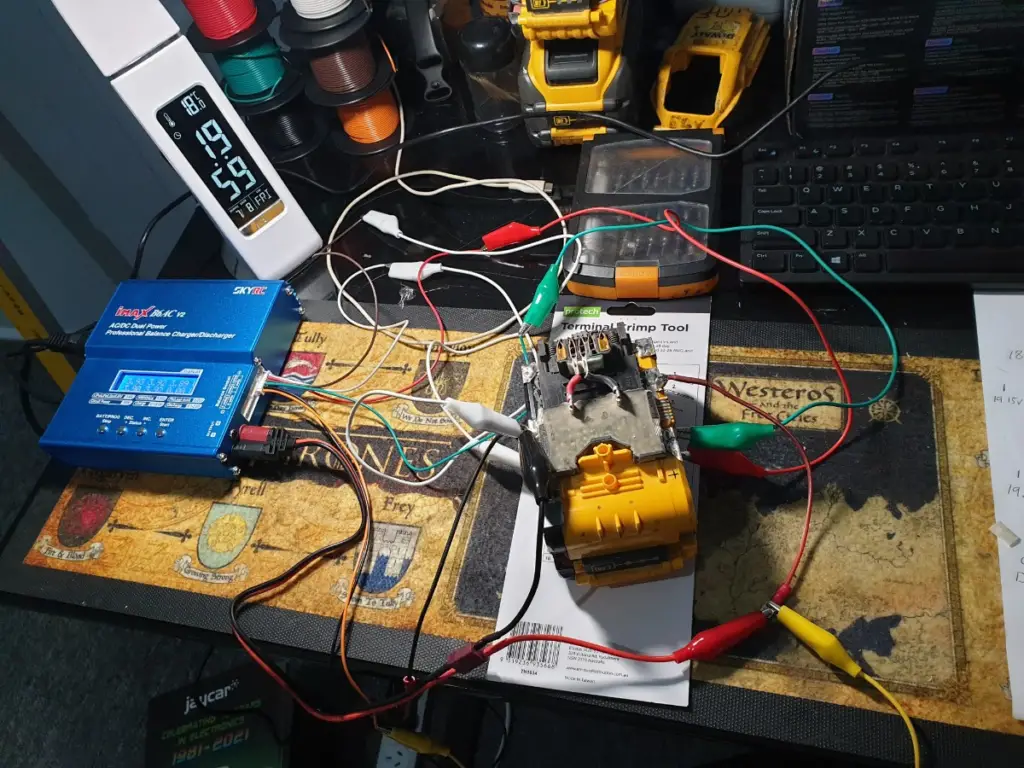
Can You Leave a DeWALT Battery on the Charger Overnight?
In normal use with a compatible modern DeWALT charger, the charger manages the charging process automatically rather than continuously forcing maximum current into a full battery.
However, for long-term storage, DeWALT recommends keeping battery packs in a cool, dry location away from excessive heat or cold. DeWALT documentation also recommends storing a fully charged battery in a cool, dry place out of the charger for extended storage.
So leaving a battery installed for a little while after it finishes charging generally isn’t the same as actively overcharging it, but there is little reason to permanently store every battery on a charger.
Should You Charge a DeWALT Battery After Every Use?
You don’t need to completely drain a modern lithium-ion battery before recharging it.
In fact, lithium-ion batteries don’t have the same “memory effect” associated with some older rechargeable battery chemistries.
For everyday tool use, topping up a partially discharged battery is completely practical.
If you know you have a large job tomorrow, charging your batteries beforehand is usually more convenient than deliberately draining them first.
Does Fast Charging Damage DeWALT Batteries?
Using a genuine compatible DeWALT fast charger is fundamentally different from forcing uncontrolled current into a battery.
The charger and battery pack electronics work together to control charging.
DeWALT’s DCB118 and DCB1112 also use fan-assisted cooling, specifically helping manage battery temperature during the charging process.
Heat remains one of the major enemies of lithium-ion cells, so proper temperature management is important.
For most users, I wouldn’t avoid DeWALT’s official fast chargers out of fear that simply charging faster will immediately ruin the battery.
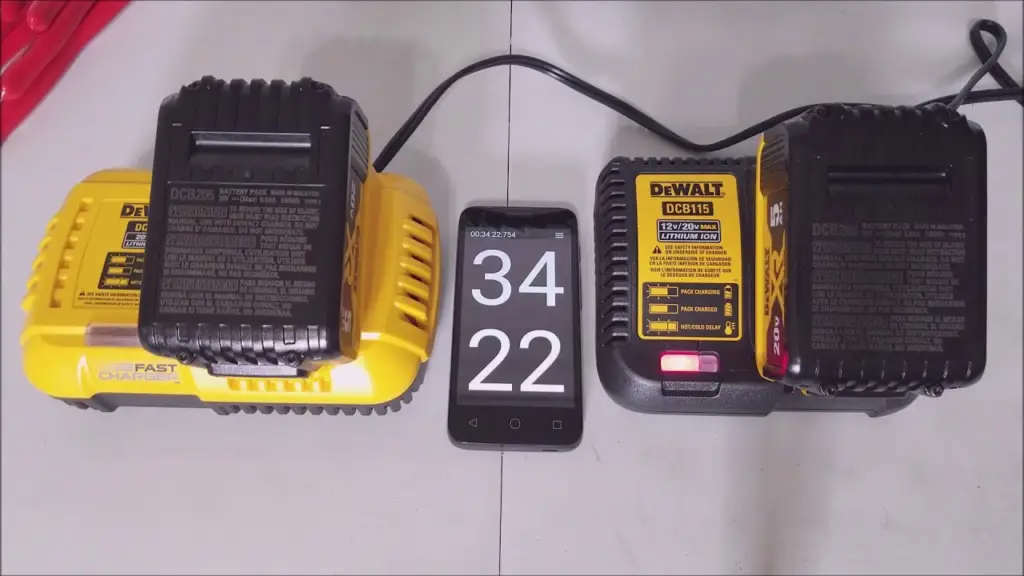
4 Amp vs 6 Amp vs 8 Amp vs 12 Amp DeWALT Charger
Here’s the simplest way to choose:
| Charger Type | Best For | Verdict |
|---|---|---|
| 4 Amp | Home DIY, occasional tool use | Best budget/general option |
| 6 Amp | Frequent DIY and light professional use | Best all-around balance |
| 8 Amp | Professionals and FLEXVOLT users | Excellent fast charger |
| 12 Amp | Heavy professional use | Best for minimum downtime |
For someone who uses drills and impact drivers occasionally, a 4-amp charger is perfectly adequate.
If you’re running saws, grinders, landscaping equipment, or FLEXVOLT tools throughout the day, moving to an 8- or 12-amp charger is much easier to justify.
How to Make DeWALT Batteries Charge More Efficiently
A few simple habits can help:
- Let extremely hot batteries cool before charging.
- Keep charger ventilation openings clear.
- Charge batteries in a dry, moderate-temperature environment.
- Use a charger designed for your specific DeWALT battery platform.
- Don’t use cracked, swollen, severely damaged, or leaking batteries.
- Keep battery terminals reasonably clean.
- Use an appropriate fast charger if downtime matters.
Most importantly, don’t try to modify chargers or bypass battery protection circuitry to make batteries charge faster.
Are DeWALT Fast Chargers Worth It?
For professionals, usually yes.
Think about the difference between waiting an hour and waiting several hours for a large battery. If a dead battery means a worker, saw, mower, or other tool sits unused, faster charging can quickly become valuable.
A fast charger is especially worthwhile if you own:
- FLEXVOLT batteries
- 6Ah or larger 20V MAX batteries
- High-draw saws or grinders
- Outdoor power equipment
- Several cordless DeWALT tools used throughout the day
For a homeowner with several batteries in rotation, however, buying another battery can sometimes provide more practical value than buying the fastest charger available.
DeWALT Battery Charging Review
DeWALT’s charging ecosystem is one of its strengths because users can choose a charger that matches how they actually use their tools.
The DCB1104 4A is a sensible everyday option. The DCB1106 6A offers a strong middle ground. The DCB118 8A is particularly attractive for FLEXVOLT users, while the DCB1112 12A is designed for people who place a premium on minimizing downtime. DeWALT currently lists all four types in its charger lineup.
The main drawback is that charging-time claims can become confusing. Battery capacity, model generation, temperature, and maximum accepted charging current all influence the real result, so there isn’t one universal answer.
Overall rating: 9/10
Charging speed: 9/10
Battery compatibility: 9/10
Fast-charger options: 10/10
Ease of use: 9/10
Value: 8.5/10
Final Verdict
So, how long do DeWALT batteries take to charge?
For most common batteries, roughly 30–90 minutes is a reasonable expectation when paired with an appropriate modern charger.
Compact packs can be ready faster, while high-capacity 20V MAX and FLEXVOLT batteries may take one to several hours depending on the charger.
The key takeaway is simple:
Battery Ah determines how much energy needs to be replaced, while your charger largely determines how quickly that can happen.
If you use DeWALT tools casually, a 4A charger should be sufficient. For frequent professional use, a 6A model is a worthwhile step up. And if you’re regularly cycling through large FLEXVOLT batteries, an 8A DCB118 or 12A DCB1112 can dramatically reduce downtime.
For anyone buying into the DeWALT cordless platform today, I’d recommend choosing the charger based not just on voltage compatibility, but on the size of the batteries you actually intend to use.
READ ALSO: Best Router Sled for Slab Flattening